Jaw crushers are the mainstay of the primary crushing stage in mining, quarrying, and aggregate production. Their performance hinges on the jaw plates—critical wear parts that interact directly with the raw material, cutting rock, ore, or concrete to manageable dimensions. Choosing the right jaw plates for your Sandvik crusher is not just about maximizing productivity; it’s about optimizing service life, minimizing downtime, and reducing total operating costs.
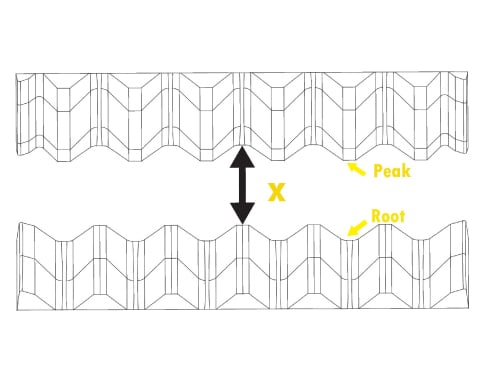
The following is a targeted selection guide, providing detailed recommendations based on material properties, operating conditions, and equipment models:
I. Core Selection Logic: Precisely Matching Raw Material Hardness
Sandvik jaw crushers typically employ a “single toggle plate” structure, primarily composed of a “fixed jaw plate” and a “moving jaw plate.” We recommend selecting jaw plates made of different materials based on the hardness and crushing ratio of the raw material:
1. Soft Raw Materials (Limestone, Halite, etc.)
Recommended Material: High Manganese Steel (M12/M18)
Reason for Application: These raw materials have low hardness, resulting in less impact on the plates. The strength and toughness of the plates are crucial. M12/M18 combines toughness and wear resistance, offering high cost-effectiveness.
Our Advantage: Our high manganese steel undergoes special heat treatment, ensuring the plates are less prone to breakage under high impact, resulting in a longer service life.
2. Medium-Hard Raw Materials (Basalt, Diabase, etc.)
Recommended Material: High Manganese Steel (M24/M30)
Reason for Application: These stones are hard and highly abrasive. M24/M30 offers higher wear resistance, significantly extending service life.
Our Advantages: Our high-manganese steel plates undergo fine polishing to reduce the friction coefficient between the plate and the material, improving crushing efficiency.
3. Extremely Hard Raw Materials (Quartzite, Diamond Ore, etc.)
Recommended Material: Carbide or Ceramics Composite Material
Reason for Application: Extremely hard stones cause significant abrasion to metal plates, leading to rapid wear of ordinary steel plates. While carbide is more expensive, it can withstand highly abrasive environments.
Our Advantages: Our carbide plates are made of high-hardness tungsten steel, possessing extremely high wear resistance and strength, making them suitable for extreme working conditions.
II.Tooth Patterns: Matching Profile to Application
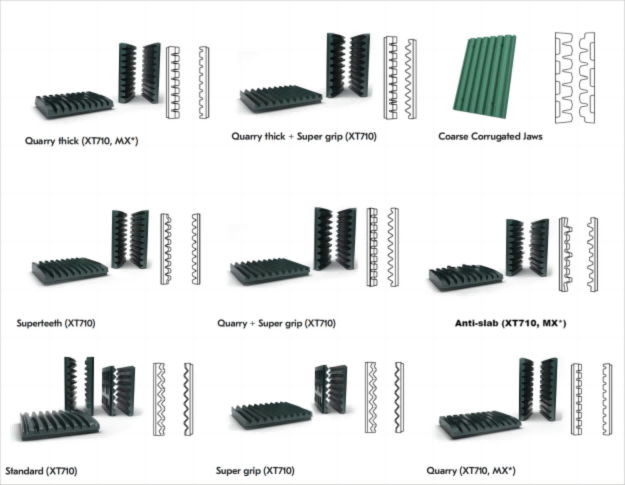
The tooth pattern on jaw plates influences grip, fines generation, and wear distribution. Sandvik offers seven primary patterns:
1.Wide Teeth (WT):
Design: Broad, flat teeth for high wear resistance.
Best For: Feed with high fines content (e.g., clay-rich materials).
2.Wide Wave (WW):
Design: Wavy profile for slabby, less abrasive feed.
Best For: Easy-to-crush materials like soft limestone.
3.Corrugated (C):
Design: Grooved surface for small CSS settings.
Best For: Low-abrasion materials requiring tight top-size control.
4.Coarse Corrugated (CC):
Design: Deeper grooves for abrasive feed.
Best For: Large CSS settings and high AI materials.
5.Sharp Teeth (ST):
Design: Aggressive grip for flaky or angular feed.
Best For: Materials prone to slippage (e.g., flaky granite).
6.Heavy Duty (HD):
Design: Ultra-thick, robust profile.
Best For: Extremely abrasive ores (e.g., taconite).
7.Heavy Duty Ultra-Thick (UT):
Design: 30% thicker than HD for extended life.
Best For: Severe applications with frequent impact.
Selection Tips:
High fines content: Use WT or C plates to prevent packing.
Flaky/angular feed: ST plates improve grip and reduce slippage.
Abrasive feed: CC, HD, or UT plates withstand prolonged wear.
III. Structural Design: Advantages of a Single Jaw Plate
Moving Jaw Plate (Swivel Plate):
Typically employs an asymmetrical design, smaller in size than the fixed jaw plate, achieving a “larger top, smaller bottom” crushing chamber shape (i.e., a larger crushing ratio).
Fixed Jaw Plate (Standing Jaw Plate):
Usually made of high-toughness cast iron or manganese steel, primarily used for support and guidance, ensuring it is not easily broken under high impact.
IV. Auxiliary Selection Recommendations
A. Consider Feed Size
Large feed size (e.g., large models): It is recommended to choose a fixed jaw plate made of a harder and thicker material to withstand the impact of large stones.
Small feed size: Focus on the wear resistance of the moving jaw plate.
B. Refer to the Official Parts List
We recommend referring to the official parts list provided by Sandvik (e.g., models CJ212, CJ615, etc.) when selecting a model to confirm the specific part numbers and applicable scope.
C. Special Considerations for Operating Conditions
Mobile Crusher:
Due to its compact structure, it is recommended to select M18 or M30 grade wear-resistant plates to withstand frequent movement and start-up impacts.
Deep Crushing Chamber Design:
If the machine adopts a deep crushing chamber (such as CJ615), the strength and wear resistance of the mounting plate are even more critical.
V. Our Service Commitment
As a parts manufacturer, we not only provide high-quality original equipment manufacturer (OEM) parts, but also offer the following value-added services:
Fast Delivery:
We maintain a stock of commonly used models such as M12, M18, and M24, ensuring quick replacement during downtime and minimizing downtime losses.
Technical Consultation:
We provide professional technical support to help you predict liner life by monitoring the A-dimension (anvil wear dimension) and perform scientific replacement.
Quality Assurance:
Our products undergo rigorous quality testing to ensure a high degree of compatibility with Sandvik original machines and high assembly precision.
Conclusion
Please select the appropriate jaw plate combination based on your crusher model (e.g., CJ212, CJ615), raw material hardness (soft/medium-hard/extremely hard), and crushing ratio requirements. For further confirmation of specific product numbers or pricing, please feel free to contact us.






Leave a Comment